Estimated read time: 21 minutes
This field guide may contain affiliate links - if you make a purchase via these links, we may earn a commission at no extra cost to you.
Quick Jump To: How External Rentals Work / Tips for the Florida Heat / Using at Disney / Choosing Right For Your Needs / Checking Your Rental
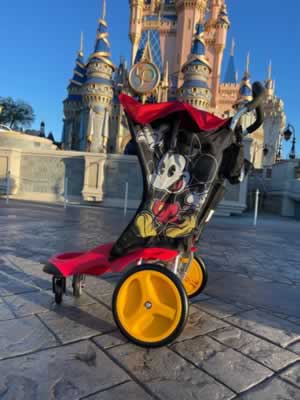
Disney's in-park rental strollers (like the one pictured) are built for durability rather than comfort. They are made of hard moulded plastic with a simple fabric sun shade and small mesh pockets, but they do not recline and have no padding, which means they are not ideal for infants or for children who might want to nap in the parks. Disney rents these single strollers for about $15 per day (doubles for $31 per day), with a slight discount if you prepay for multiple days. That daily cost can add up quickly for a week-long holiday, especially if you need more than one stroller.
Another major limitation is that Disney strollers must be returned at the park exit and cannot be taken beyond the gates. If you leave Magic Kingdom and head to the car park or a Disney hotel, you have to give the stroller back and carry your child or have them walk. The same goes for park-hopping - you would need to drop off the stroller when exiting one park and then rent a new one at the next park (Disney does let you avoid paying twice in one day by showing your receipt). The inconvenience is obvious: you might end up lugging a tired toddler from the bus to your hotel room at night because the rented pushchair can't leave the park. Disney's wheelchairs and mobility scooters (ECVs) have similar rules - they're only available inside the parks and must be left behind when you exit, so they can't help you with the long walk to the parking lot or on resort grounds. There is also no Disney stroller or wheelchair rental at the resort hotels, and supply can run out on busy days (especially ECVs, which often get fully booked by late morning).
Benefits of Renting from External Companies
Using an outside stroller rental company for your Disney trip can solve many of these issues. Third-party providers often offer much better value over multiple days - for example, a seven-day single stroller rental can cost as low as $70 total from an outside vendor, versus about $91 if you rented each day from Disney. In other words, you're paying roughly half price per day by renting externally for the length of your stay. For a double stroller or longer trips, the savings are even greater. Even on a shorter visit, many families find it worth spending a similar amount to get a far superior stroller that they can use everywhere, rather than paying Disney's rates for a basic model only usable in the parks.
Comfort and features are a big advantage of external rentals. The strollers available from independent Orlando companies are typical consumer models - often Baby Jogger City Minis, BOB joggers, or similar - which means they come with padded seats, full sun canopies, and reclining backrests for when your child wants to nap. In contrast to Disney's hard plastic carts, these plush strollers feel more like the one you use at home. They also usually include handy accessories: cup holders, storage baskets, rain covers, and sunshades are commonly provided or available as add-ons. Many outside rentals even have double strollers with two separate seats (much more comfortable for siblings than Disney's bench-style double) and special needs strollers for older kids or children with disabilities. Overall, you have a wider selection of stroller types to fit your family's needs - from lightweight travel buggies to all-terrain jogging strollers.
Perhaps the greatest benefit is flexibility. When you rent from an external company, the stroller is yours to use for your entire holiday - not just inside one theme park. You can use it at your hotel, on the way to and from the parks, at Disney Springs, and anywhere else you go. That means no carrying an exhausted child through the resort or to the car park at the end of the day. The stroller goes with you on Disney's transport (buses, monorail, etc.) just like a personal stroller would. Families often find this a lifesaver when a little one falls asleep on the ride back to the hotel - you can simply roll them to your room. The same flexibility applies if you rent a wheelchair or mobility scooter externally: you'll have the device 24/7, instead of only when inside a park. Additionally, outside companies typically offer free delivery and pickup at your hotel and lower daily rates for longer rentals, which adds to the convenience and cost savings.
There are several well-known independent rental companies in Orlando that serve Disney visitors. For example, Stroller To Go, Kingdom Strollers, Orlando Stroller Rentals, Cloud of Goods, and MagicStrollers.com are popular options for pushchair rentals. Many also rent mobility aids; Disney's own featured provider is ScooterBug, which offers strollers, wheelchairs, and ECV scooters. (ScooterBug has a special arrangement allowing drop-offs at Disney resort bell desks.) It's a good idea to compare a few companies - their stroller models, prices, and terms - but you'll generally find all of these providers offer similar services: quality equipment, multi-day discounts, and delivery to your hotel.
How External Rentals Work
Booking a stroller or wheelchair from an outside company is usually done online in advance. You'll select the type of stroller or mobility device you need and the dates of your rental, and provide your hotel details. It's wise to reserve before your trip (especially for peak travel periods) to ensure availability. The rental company will arrange delivery to your resort on or before your arrival day. If you're staying at a non-Disney hotel in Orlando, the process is very simple: the stroller can typically be dropped off with the bellhop or front desk before you arrive, and you can pick it up at your convenience. The stroller will be tagged with your name, and hotel staff can hold it for you until check-in. For Disney-owned hotels, there is an extra step - Disney currently requires that you meet the delivery person in person rather than allowing an unattended drop-off. This means you'll set up a meeting time (often in the lobby or at the front entrance) to receive the stroller or scooter from the rental company. Companies like ScooterBug (Disney's preferred vendor) are an exception: they are allowed to leave your rental with Bell Services for you to collect at any time. If you use other providers, you just need to be available at the agreed time. Typically, the rental company will text you when they're on the way and hand off the stroller directly to you with any instructions.
Once you have your stroller or wheelchair, you keep it with you for the duration of your rental period. You can use the same stroller across multiple parks and days - it comes and goes with you, just like a personal item. For example, you can wheel your child from your hotel room to the bus, fold the stroller to board the bus, unfold at the park gates, and you're off for the day. You won't need to line up at the Disney stroller rental each morning or swap strollers when changing parks. At the end of your trip, return is handled similarly to delivery. If you're at a Disney resort, you'll coordinate a meeting time for the company to retrieve the stroller (Disney policy again requires you to hand it back in person). At other hotels, you can often leave the stroller with Bell Services or the front desk on your departure day, and the rental company will pick it up after you check out. It's all fairly hassle-free - the vendors are very experienced with Disney guests and will communicate the drop-off and pick-up procedures clearly. Using an external rental thus lets you set it and forget it: you get a stroller or wheelchair for your whole holiday and don't have to worry about daily returns until your vacation is over.
Tips for Using Strollers in the Florida Heat
Visiting the Orlando parks with young children means dealing with heat, rain, and a lot of walking. Here are some practical tips to keep your little ones comfortable and make the most of your stroller rental:
- Prepare for sudden rain: Florida is notorious for afternoon downpours, even on otherwise sunny days. Carry a rain cover for your stroller (or a large poncho that can drape over it) so you can quickly shield it during showers. This keeps the seat dry for your child and also protects any belongings stored in the stroller. It's also smart to pack a small towel - you can use it to dry off the stroller after a rainstorm or to wipe away sweat and spills.
- Sunshade and cooling: The sun in Florida can be intense. Ensure your rented stroller has a good sun canopy; most external rental buggies have large adjustable canopies that provide ample shade. You can also improvise additional shade by clipping a light blanket or towel to extend the cover (just ensure airflow is not blocked). In the summer, a stroller fan is a lifesaver - these are small clip-on fans (often battery-powered or USB rechargeable) that attach to the stroller and provide a breeze for your child. They really help on hot, still days. You might also consider cooling towels for your kids: a damp cooling towel or a misting spray bottle can help them stay cool in the stroller.
- Keep water accessible: Staying hydrated is critical in the heat. Use the stroller's cup holders or storage pockets to keep water bottles and sippy cups within easy reach. It's a good idea to have a bottle of water for each child (and yourself) and take frequent water breaks. The stroller's storage basket is also handy for carrying a small cooler bag with extra drinks or snacks, especially if you'll be out all day. Encourage kids to sip water often, even if they're riding passively in the stroller, to prevent heat exhaustion.
- Plan for naps and breaks: One of the best things about having a comfortable stroller is that your child can nap on the go. Plan some downtime each day when your little one can sleep in the stroller or at least relax. Many strollers from external companies recline nearly flat, turning the seat into a decent nap spot. Try to find a shaded, quiet corner or do some leisurely laps around a less busy area while your child naps. During the hottest part of the afternoon, consider visiting an indoor show or the baby care center - somewhere air-conditioned - where you can park the stroller nearby and let them rest. Midday breaks back at the hotel are another option if you prefer to get out of the heat entirely (you can roll the stroller to your room). Either way, scheduling a nap or rest period will help prevent meltdowns. Remember: a relaxed child in a stroller means a more relaxed parent!
- Expect long distances: Even with a stroller, be prepared for a lot of walking at Disney World. The four parks are enormous - you may walk 7 to 10 miles (11-16 km) in a day when touring. Little legs will tire quickly. It's very common for children as old as five, six, or even seven to end up in a stroller at Disney, even if they haven't used one at home for years. Don't be afraid to rent a stroller for older toddlers or pre-schoolers; by midday, they will likely be glad for a place to sit. Plan your day knowing that walking from one end of Epcot to the other, or doing multiple loops in Magic Kingdom, is a big trek for a child (and for you!). Use the stroller parking areas and let your kids ride as much as they need. Also, mind your own feet - wear comfortable shoes and take breaks so you have the energy to push that stroller around the parks all day.
Using Wheelchairs and Mobility Scooters at Disney
Walt Disney World is very accommodating to guests with limited mobility. All the parks, hotels, and transport systems are built with wheelchair access in mind, so you can navigate pretty much everywhere without facing stairs or barriers. The terrain in the parks is generally flat and smooth (mainly pavement or concrete paths), and where there are inclines or steps, there will be a ramp or elevator alternative. That said, “accessible” doesn't mean effortless - you may be covering long distances just like any guest. It's not unusual to travel several kilometres in a day at Disney World, even using a wheelchair. If you have mobility challenges, renting an electric mobility scooter (ECV) can significantly ease the strain of those distances. Many visitors who don't normally use a scooter at home will rent one for Disney because of the sheer amount of walking involved (including the stretches from transportation areas into the park gates, and within large resort hotels).
Buses and monorails: Disney's transportation is fully equipped to handle wheelchairs and scooters. All Disney park buses have motorised ramps and designated spaces for at least two wheelchairs or ECVs on board. When a bus pulls up, just wait in the marked accessible queue area; the driver will deploy the ramp and help guide you on. Wheelchairs and scooters are strapped in for safety during the journey, and the driver can assist with the tie-downs. You can choose to transfer to a regular seat on the bus if you prefer (and if you're able), or remain in your wheelchair/ECV for the ride. The monorail system is also very easy to use with a mobility device - each monorail station either has a lift (elevator) or is built on a slope to provide step-free access to the platform. When the monorail arrives, a Cast Member will place a small ramp between the platform and the monorail car for you to roll on board. It's a smooth process and you can usually ride inside the monorail without leaving your wheelchair or scooter. Likewise, the Disney Skyliner gondolas and most of the boats/ferries have accommodations for wheelchairs (the larger ferry boats and some resort launches can take mobility devices, though a few smaller water taxis might not). Disney transportation staff are very experienced with loading and unloading guests in wheelchairs, so don't hesitate to use any of these options - you won't be an inconvenience at all. Just keep in mind that during busy times (park closing rush, etc.), the accessible spots can fill up, and you might have to wait for the next bus or monorail if two wheelchairs are already aboard. To avoid long waits, you can try to travel at off-peak times, but generally the system works well even when it's crowded.
Hotels and queues: All Disney hotels are designed to be accessible. You'll find ramps or elevators instead of stairs at entrances, lifts to all floors, and hallways wide enough for wheelchairs. If you have an ECV or wheelchair, you can drive/roll it right into your resort room (most standard hotel rooms can accommodate a wheelchair; for scooters you may need to park it in the room entry area or near a bed). In some of the sprawling resort hotels, you might request a room near the lobby or amenities when you book, to minimise the distance you need to travel within the resort. As for the park attraction queues, nearly all rides and shows have wheelchair-accessible queues. Disney's newer rides are built so that wheelchairs can go through the regular queue up until the boarding area. On many attractions, you can stay in your wheelchair all the way to where you load (and in some cases, on the ride for experiences that don't require transferring, like certain shows or slow-moving rides). If a particular queue has an impediment (for example, some older rides have narrow queue lines or stairs), just speak to the Cast Member at the entrance - there is always an alternate route or procedure for guests in wheelchairs. They might direct you to a different entrance or give you a return time to come back via the exit. The goal is that you won't miss out on any attraction due to mobility issues. If you have a personal stroller for a child with a disability, you can also request a special “stroller as wheelchair” tag at Guest Services. This tag allows you to use the stroller in lieu of a wheelchair, meaning you can bring it into wheelchair-accessible areas and queues that normally require strollers to be parked outside. This is a fantastic accommodation for children who may have autism or other conditions - the familiar stroller can act as a safe space and you won't need to carry your child in line. Overall, Disney's parks are very wheelchair-friendly; just be aware of the large scale of everything and plan accordingly (allow extra travel time to get from place to place, and take breaks as needed).
A few extra notes for ECV (scooter) users: Driving a mobility scooter in the crowded parks can be a bit daunting at first, but you'll get the hang of it quickly. Keep the speed setting on low in congested areas, and always be mindful of people walking in front of you (pedestrians can be unpredictable - they may stop or turn suddenly). Disney crowds are generally used to ECVs, but do try to avoid any quick movements to prevent bumping anyone's ankles. All the rental ECVs have horns - a polite toot can alert a distracted person if needed. Battery life is another consideration: most rental scooters will hold a charge for a full park day, but it's wise to charge it each night in your hotel room. If you're staying in a Disney resort, you can bring the ECV into your room to charge (or sometimes the hotel can assist with finding a charging spot). And one tip: at security bag check, you may be directed to a separate wheelchair/ECV line which is wider - look out for the accessibility symbol or ask a staff member if you're unsure where to go.
Choosing the Right Stroller or Wheelchair for Your Needs
For strollers: consider your child's age, size, and habits to pick the best model. If you're traveling with an infant or baby under 6 months, you'll need a stroller that reclines fully to a near-flat position, since little ones can't sit upright for long periods. Some rental models can accommodate an infant car seat or have a bassinet attachment - check with the rental company if you need that feature. For babies and toddlers, a 5-point harness (with shoulder straps) is preferable to keep them secure; note that Disney's park strollers only have a simple lap belt, which is one reason they're not suitable for very small babies. Thankfully, most external rental strollers come with proper harnesses and padding. If your child is a toddler or pre-schooler, a standard model like a City Mini GT or similar will usually be fine. These strollers typically have high weight limits (often around 25-30 kg, or 55-65 lbs), which covers the average 5- or 6-year-old. If you have a larger child or a child with special needs who requires a stroller, look into the special needs strollers some companies offer - for example, the popular Liberty or Special Tomato brand adaptive strollers. These have higher weight capacities and roomier seats for older kids, ensuring they're comfortable and safe. Always check the weight and height guidelines on the rental company's website to choose an appropriate model for your child.
If you have two young children, you'll also need to decide between a double stroller or two singles. A double stroller (side-by-side style) is convenient because one parent can push both kids at once, and you only have one thing to keep track of. The external rental doubles are easy to manoeuvre and do fit through standard doorways (they're within Disney's size limits), but they are wider and heavier than a single. Some parents find a double stroller a bit cumbersome in crowded areas or when folding onto transport. The alternative is renting two single strollers - this gives each child their own space and can be simpler to handle individually, but of course it requires two pushers (or one parent switching between strollers). Think about your kids' personalities: if one tends to nap while the other is active, having separate strollers might allow one parent to go for a walk with the awake child while the other rests. On the other hand, if one parent will often be alone with both kids, a double is practically a must. Also consider whether your children squabble when seated together; Disney's rented double strollers, for instance, have no divider between the two seats, leading to potential elbowing matches. Most third-party double strollers have separate seat areas, which helps. In any case, measurements shouldn't be a worry - Disney's rule is strollers must be within 31 inches wide by 52 inches long, and all the common rental models adhere to this. Finally, if you plan on using the stroller outside of Disney (say, at other attractions or around the city), factor in how portable it is. Models like the City Mini fold easily and are relatively lightweight, whereas a double jogger is bulkier. Choose what will serve you best both in the parks and beyond.
For mobility aids (wheelchair vs. ECV): picking the right option depends on the user's mobility and comfort level. An electric scooter (ECV) is ideal if the person can neither walk long distances nor self-propel a wheelchair easily, and is comfortable operating a battery-powered vehicle. ECVs allow for independence - the user can control their movement and doesn't need someone to push them. This can be a great confidence booster and energy-saver for anyone who tires quickly due to age, disability, or health conditions (for example, those with joint pain, low stamina, or breathing issues in the heat). If the person uses a mobility scooter or cart in daily life (like at supermarkets), they will likely do well with an ECV at Disney. Modern rental scooters are easy to drive, with a simple handlebar throttle and steering similar to a bike or shopping cart. They have adjustable speed settings and are quite agile, though crowds can be challenging - as mentioned, you have to be attentive when navigating through pedestrian traffic. The pros of an ECV are that you won't need assistance from your party to get around, and you can cover a lot of ground with minimal physical strain. Just remember to charge it each night and perhaps midday if you have a break, so you don't run low on battery. The cons are that scooters can be a bit bulky in tight shops or restaurant spaces, and some people may feel self-conscious at first. However, thousands of guests use ECVs at Disney every day - it's very common and nothing to be anxious about. If renting, confirm the scooter's weight capacity and size with the provider (nearly all rentals are within the standard 32" x 48" size that Disney transportation can accommodate, and usually support at least 250-300 lbs). If the user is on the heavier side or needs extra stability, a four-wheeled ECV might be preferable to a three-wheeled model (four-wheel models are slightly larger but offer more stability on turns).
A manual wheelchair might be the better choice in other scenarios. If the person does not feel comfortable controlling an electric scooter or only needs assistance part of the time, a wheelchair can be perfectly sufficient. Wheelchairs are simpler devices - no batteries, no controls to learn - and they fold up for easy transport in cars or on buses if needed. They're also a bit easier to weave through crowds or narrow spaces. The trade-off is that someone has to push (unless the user can self-propel, which can be tiring over long distances or for extended periods). For an elderly family member who perhaps can walk short distances or stand in some queues, a wheelchair gives flexibility: they can ride when they're tired and get out and walk when they want a break or when terrain makes it easier. If you have multiple people in your group who can take turns pushing, a wheelchair might work well and you avoid worrying about driving an ECV. It's also a little easier to manage with young children around, since the pusher can stop on a dime - whereas an ECV has a slight learning curve to brake smoothly. Consider the environment and length of use: if you're park-hopping and out for 12+ hours a day, an ECV will greatly reduce fatigue for the user and the family member who would otherwise be pushing. But if you're doing shorter outings or the person only struggles in certain circumstances, a wheelchair could be fine. Another factor is transport and space: if you're staying off-site and renting a car, note that wheelchairs fold and fit in a car boot easily, while ECVs are heavy and often require disassembly to transport in a car. (Some rental scooters are portable and come apart, but you'll need a strong helper and some boot space.) If staying on-site and using Disney buses, this is less of an issue since you can drive the ECV directly onto the bus.
In summary, match the device to the person's needs and comfort. Some guests even do a combination - for instance, renting an ECV for a grandparent and a pushchair for a child, and possibly a wheelchair on standby if another adult has intermittent trouble walking. Whatever you choose, take a little time on your first day to get familiar with it (adjust seating, practice folding a stroller or steering a scooter). Both strollers and wheelchairs/ECVs are meant to enhance your trip, not hinder it, so picking the right one ensures everyone in your group can enjoy the parks with less stress.
Checking Cleanliness, Condition, and Terms of Rental
When your rented stroller or wheelchair is delivered, it's a good idea to inspect it briefly for cleanliness and proper function. Reputable rental companies take pride in providing equipment that is cleaned and sanitised between each use - you should receive a stroller that looks fresh, with no sticky mess or lingering odours, and a scooter that's in good working order. Still, do a quick check: ensure the stroller's buckles and brakes work, the wheels roll smoothly, and that any included accessories (like a rain cover or cooler bag) are present. For wheelchairs/ECVs, test the brakes or power switch and look for any obvious damage. If something is not up to standard, notify the rental company right away - they can usually swap out the equipment or instruct you if a minor adjustment is needed. It's smart to pack a few antibacterial wipes so you can give handles and high-touch surfaces an extra wipe-down yourself, just for peace of mind and hygiene (especially important in flu season or if your child has sensitive skin). Overall, external companies are known for well-maintained gear, often in much nicer condition than the hard-used Disney park strollers, so you'll likely be pleasantly surprised by the quality.
Before you set off, make sure you understand the rental terms and conditions that you agreed to. Cancellation policies are important in case your plans change - for example, many companies offer a full refund if you cancel at least 48 hours in advance of your rental start date, but may charge a fee if you cancel closer to the date. It's worth checking the specific cancellation window and procedure (some require an email or phone call, while others let you cancel via a link in your confirmation). Also note whether the company requires a deposit or holds your credit card on file - and what their policy is if you return the stroller early or decide to extend your rental (extensions are usually possible with a quick call, often at a modest daily rate). Another key aspect is damage or loss liability. Read the fine print about what happens if the stroller or scooter is damaged, lost, or stolen during your rental. Generally, you are responsible for the equipment while it's in your care and may be charged the repair or replacement cost if something happens to it. For instance, if a stroller were to disappear from a theme park stroller parking area (a rare scenario, but it can happen), the contract might stipulate you pay the replacement value. To mitigate this, some companies offer optional insurance for a few dollars per day, which can cover accidental damage or theft. If you're worried, consider opting in - otherwise, just be mindful to always park your stroller in designated areas and perhaps avoid leaving it unattended for very long with valuables inside. With scooters, take the keys with you when you park them (so no one else can drive off). Know the rules about returning the equipment as well: most companies require strollers to be returned to a bell desk or to a representative by a certain time on your departure day. Failure to return on time could incur extra charges, so set a reminder for yourself on that last day. As long as you follow the guidelines - and treat the rented stroller or wheelchair as if it were your own - you shouldn't have any issues. Checking the terms and doing a quick once-over on the equipment will ensure a smooth, worry-free rental experience from start to finish.
Guide Updated: 19 January 2026
